The year 2025 has once again demonstrated that the economic value of flexibility from battery energy storage systems (BESS) is enormous. However, simply looking at total revenues is often not enough for investors and operators. Another crucial question is: Where were these revenues actually generated? Our evaluation of 1.5- to 2-hour battery systems from the 2025 portfolio clearly shows that those who rely on rigid strategies are leaving money on the table. Cross-market optimisation is no longer a ‘nice-to-have’ but a decisive lever for profitability.
Why Rigid Marketing Strategies Are Reaching Their Limits
Anyone who still believes that battery storage can simply be placed on the market across the board, as was common practice in the past, is seriously mistaken. The reality on the trading floor paints a different picture: the volatility of the energy markets demands enormous agility. We observe in our portfolio that the optimal revenue ratio varies enormously – not only seasonally, but from day to day and from quarter hour to quarter hour.
A static allocation of capacities inevitably leads to opportunity costs. Sometimes the highest prices are found in intraday trading, while a few minutes later the power price for secondary control power (aFRR) is the profit driver. This dynamic can also be easily understood externally: a look at the spot market prices in the energy charts of Fraunhofer ISE impressively visualises how strongly the spreads fluctuate during the course of the day and why rigid trading fails.
Cross-market optimisation means viewing these fluctuations not as a risk, but as an opportunity. The aim is to dynamically place assets where flexibility currently has the highest value.
The Revenue Mix in 2025: Farewell to FCR Predominance
Let us take a closer look at the figures. We have analysed the performance of our portfolio of 1.5- to 2-hour battery storage systems over the entire year 2025. The result is likely to come as a surprise to many market observers.
Over the year as a whole, around two thirds of revenues still come from the trading of balancing capacity and balancing energy (specifically 67%). Here is the breakdown of weighted average revenues:
Over the year as a whole, two-thirds (67 per cent) of revenues still come from the trading of balancing capacity and power and balancing reserves. Here is a breakdown of the weighted average revenues:
- Wholesale (spot markets and arbitrage trading): 33%
- FCR (Frequency Containment Reserve): 9%
- aFRR capacity price (capacity availability): 41%
- aFRR energy price (energy activation): 17%
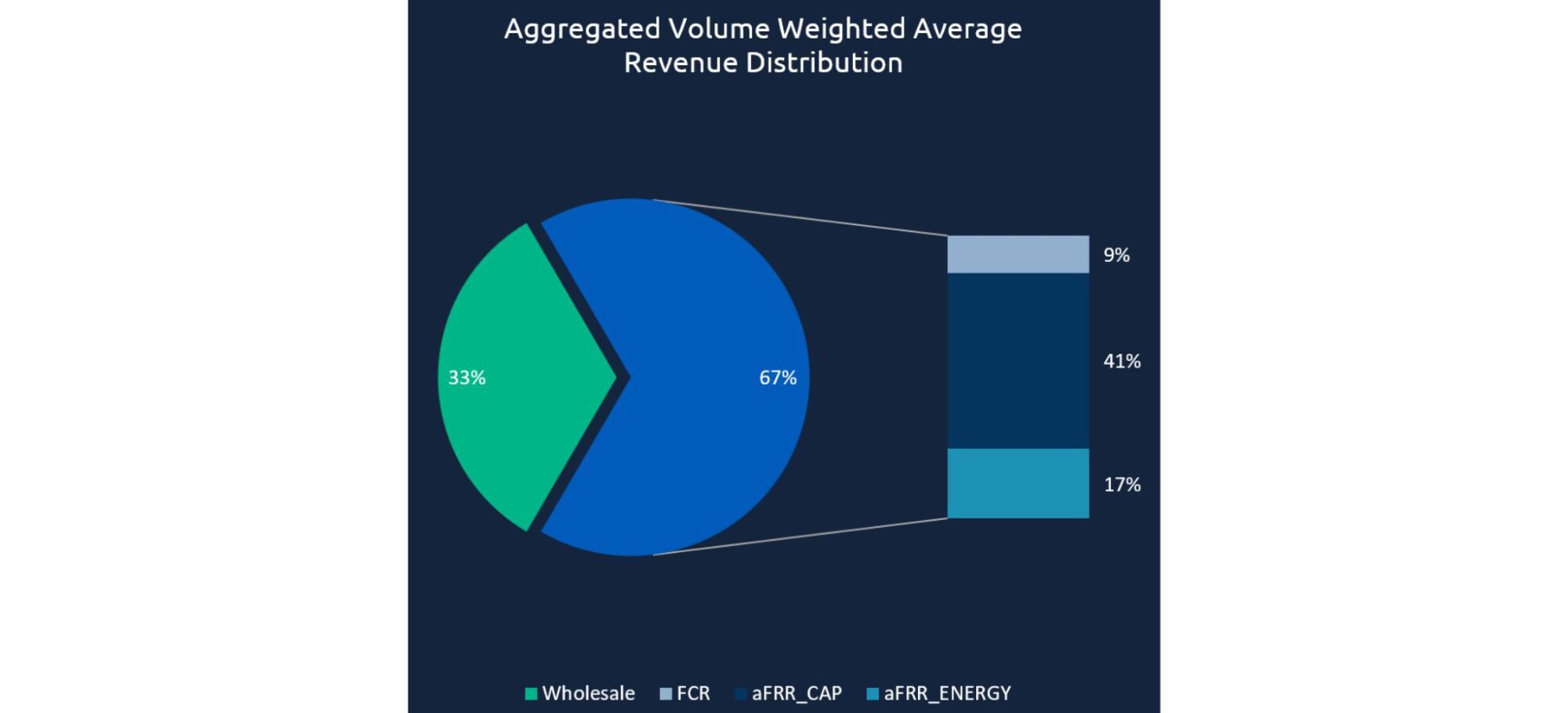
It is immediately apparent that classic primary control reserve (FCR) played a rather minor role, accounting for only 9 per cent of total revenues. The lion’s share in this area, totalling 58 per cent, went to secondary control reserve (aFRR), divided between capacity and energy markets. Those who were not prequalified here or who had their large battery storage facilities managed without actively integrating aFRR have practically ignored the largest revenue pool of 2025. In particular, the negative control labour market, with its favourable charging rates, often forms the basis for high wholesale revenues through the profitable sale of energy charged by aFRR. Although the role of wholesale management continues to grow, especially for very large storage facilities, control reserves remain the main profit driver at present.
These figures are consistent with general market trends, which show that storage facilities are increasingly replacing thermal power plants in aFRR. Detailed data on the amounts of balancing energy called upon and the average prices can also be found directly on the SMARD platform of Germany’s Federal Network Agency Bundesnetzagentur, which transparently documents the shifts in energy trading on balancing reserve markets.
Algorithm-Based Electricity Trading as the Key to Performance
How can this insight be put into practice? No human trader is capable of analysing the complex matrix of FCR, aFRR capacity, aFRR work and intraday spread at 15-minute intervals around the clock and adjusting storage charging or discharging in real time.
The key to increasing returns for battery storage therefore lies in powerful, AI-supported algorithms. In our portfolio, we use systems that calculate the economically optimal market allocation in real time. This algorithm-based electricity trading simultaneously considers all available options and autonomously decides whether it is more lucrative to trade on the intraday market or to provide capacity for aFRR in the next quarter hour.

Strategic Relevance for Battery Storage Operators and Investors
For you as an investor or operator, this reality check from 2025 means that the demands on operational management are increasing. A storage facility is only as good as the software that controls it. Trading battery storage on EPEX Spot or the control reserve markets requires a technical infrastructure that can serve all channels. Trading strategies must be seamlessly integrated with bids on the control reserve markets. At Entelios, we believe that the combination of aFRR and wholesale trading for 1.5- to 2-hour systems is currently the optimal solution.
However, it is important to remember that markets change. What was aFRR in 2025 may be a renaissance of FCR or an explosion of intraday spreads in 2026. This is precisely why cross-market optimisation is so essential. It does not commit to one horse, but always bets on the fastest. This protects your investment against regulatory or market shifts.
Conclusion: Flexibility Must Be Traded Flexibly
A glance at our 2025 portfolio is enough to consign rigid trading models to the dustbin of history. With almost 60 per cent of revenue coming from secondary control services and a third from wholesale, it is clear that diversification through intelligent control is the only way to maximise returns. Cross-market optimisation is not just an empty marketing phrase, but a hard financial necessity for every BESS business case. If you want to increase the returns on battery storage, you have to put your assets to work where the market needs them most. And that place changes every 15 minutes.
Would you like to know the potential of your storage project or how we can optimise your existing facilities using our algorithms? Let’s take a look at your data together.