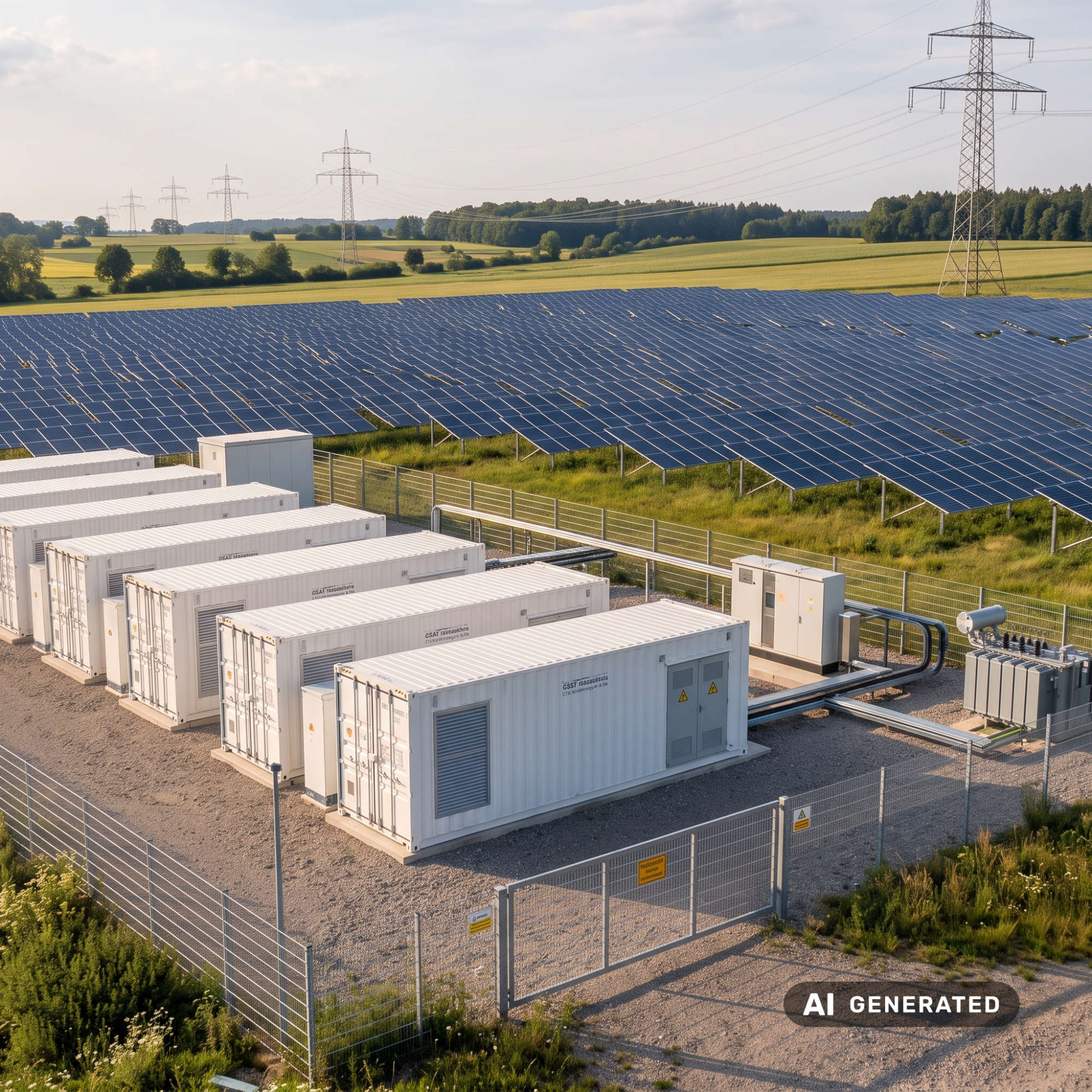
The MiSpeL regulation adopted on 1 October 2026 changes the regulatory framework for the market integration of electricity storage systems. Until now, combining subsidised renewable electricity with electricity drawn from the grid within a single storage system has only been possible to a very limited extent. With the new demarcation option, renewable electricity and grid electricity can be accounted for separately under defined conditions. This opens up new possibilities for hybrid electricity storage systems and, consequently, for co-location concepts.
This is relevant for investors, project developers and operators. After all, the business case for a battery storage system (BESS) no longer depends solely on cell costs, electricity price spreads and technical metrics. The metering concept, grid connection, regulatory framework and marketing strategy increasingly determine the actual degree of flexibility a storage system has.
Co-location projects in particular demonstrate that not all storage systems are the same.
Different Concepts, Different Degrees of Flexibility
BESS can be operated in a wide variety of configurations. These differences play a key role in determining how they can be utilised in the market.
Standalone storage systems (front-of-the-meter) are operated independently of other installations and typically have their own grid connection point. They offer a high degree of flexibility in terms of trading, as no other installation at the site needs to be included in the optimisation process.
Behind-the-meter storage systems are located behind a consumer’s grid connection point, for example at an industrial site. Here, the focus is often on optimising self-consumption, managing peak loads or optimising grid charges. Energy market applications are also possible to a limited extent, depending on the primary use case.
In co-location projects, storage systems and other assets share a site or grid connection point. These may include, for example, photovoltaic or wind power plants. Shared use and the possibility of co-location allow existing connection capacity to be utilised more effectively. At the same time, the demands on metering concepts, control systems and trading logic increase.
From Green Co-location to Mixed-source Energy Storage
In the latter case, the distinction between green and grey co-location becomes particularly relevant.
Clear boundaries continue to apply to pure feed-in grid connections or combinations of installations resulting from innovation tenders: the electricity temporarily stored in a green energy storage system must have been generated exclusively by the other parts of the installation. Charging the storage system from the public grid is therefore not permitted in this scenario.
This has a significant impact on trading. When charging, the storage system cannot freely respond to low market prices but is tied to on-site generation. Optimisation must therefore take into account generation forecasts, state of charge, subsidy logic and market opportunities collectively.
If these restrictions do not apply, MiSpeL opens up additional possibilities. The demarcation option will allow renewable electricity and grid electricity to be separated for accounting purposes in future. This provides greater flexibility, but at the same time places higher demands on metering, accounting and operational control. During the transition phase until the end of September 2027, the approval of the network operator and metering point operator is also required for the application of the MiSpeL options. The same applies in an industrial context. Here, too, the storage system can in future be allocated more flexibly to its consumers, which in turn creates new opportunities for optimisation.
Grey co-location may therefore become more economically attractive. At the same time, optimisation becomes more challenging.
Grid Connection and Restrictions Shape the Business Case
Grid connection is emerging as a key bottleneck for storage projects. In many regions, spare capacity is scarce or available only under certain conditions.
Co-location can help to make better use of existing infrastructure. At the same time, new questions arise: How is the connection capacity divided between storage and generation? What operating modes are permitted? What priorities apply in the event of grid restrictions? Is it even permitted to draw electricity, or is it purely a feed-in point?
This is where Flexible Connection Agreements (FCAs) are also gaining in importance. Such agreements may stipulate restrictions on off-take, feed-in or operating modes. For trading purposes, this means that local grid restrictions must already be factored into the optimisation logic.
For example, a storage system may detect an attractive charging signal in the intraday market, whilst the grid connection only permits a limited power intake at that moment. Such restrictions alter the revenue potential and must therefore be incorporated into the project assessment as early as possible.
Co-location can improve the business case if the project structure and marketing strategy are aligned. In the absence of such alignment, the metering concept, grid connection or regulatory requirements may limit the potential value.
Trading Becomes a Technical Discipline
The more degrees of freedom and restrictions that exist simultaneously, the more important it becomes to have a marketing approach that reliably reflects them.
The value of a storage facility arises from the ongoing decision as to which market delivers the highest contribution at any given time. Day-ahead, intraday, FCR, aFRR and mFRR place different demands on availability, energy content, response speed and bidding logic. At the same time, state of charge, grid connection capacity, metering concept and site restrictions influence every trading decision.
In grey co-location projects, this task becomes even more complex. The storage system is optimised in conjunction with other assets and the conditions at the grid connection point. Market logic and site logic must therefore be integrated into a single control logic.
What Entelios Brings to the Table as a Trading Partner
For operators and investors, the choice of the trading partner is thus increasingly becoming a strategic decision. The remuneration model and revenue forecast are important. Equally crucial is the ability to reliably account for technical and regulatory restrictions during ongoing operations.
Entelios combines experience in day-ahead, intraday and balancing reserve markets with technical expertise in the connection and control of flexible assets. Constraints such as power limits, ramp rates or site-specific operating profiles can be taken into account in the trading logic.
Entelios works with hardware and software solutions developed in-house. Projects can be integrated on a case-by-case basis, technical restrictions can be modelled precisely, and trading strategies can be adapted to changing conditions.
This integration is particularly crucial for co-location projects. The storage facility cannot be considered in isolation. The metering concept, grid connection, other assets at the site and market opportunities must all be assessed together.
Conclusion: MiSpeL Creates New Opportunities; Implementation is Key
The MiSpeL specification significantly expands the possibilities for the trading integration of energy storage systems. New degrees of freedom are emerging, particularly for co-location and mixed-energy storage projects.
At the same time, the demands on operational implementation are increasing. Innovation tenders, MiSpeL, grid connection restrictions and varying asset configurations mean that storage projects cannot be optimised using a uniform trading approach.
For investors and operators, this means that flexibility trading should be integrated into project development at an early stage. Only when the metering concept, grid connection, technical controllability and market strategy are aligned can the available scope for flexibility be utilised economically.